
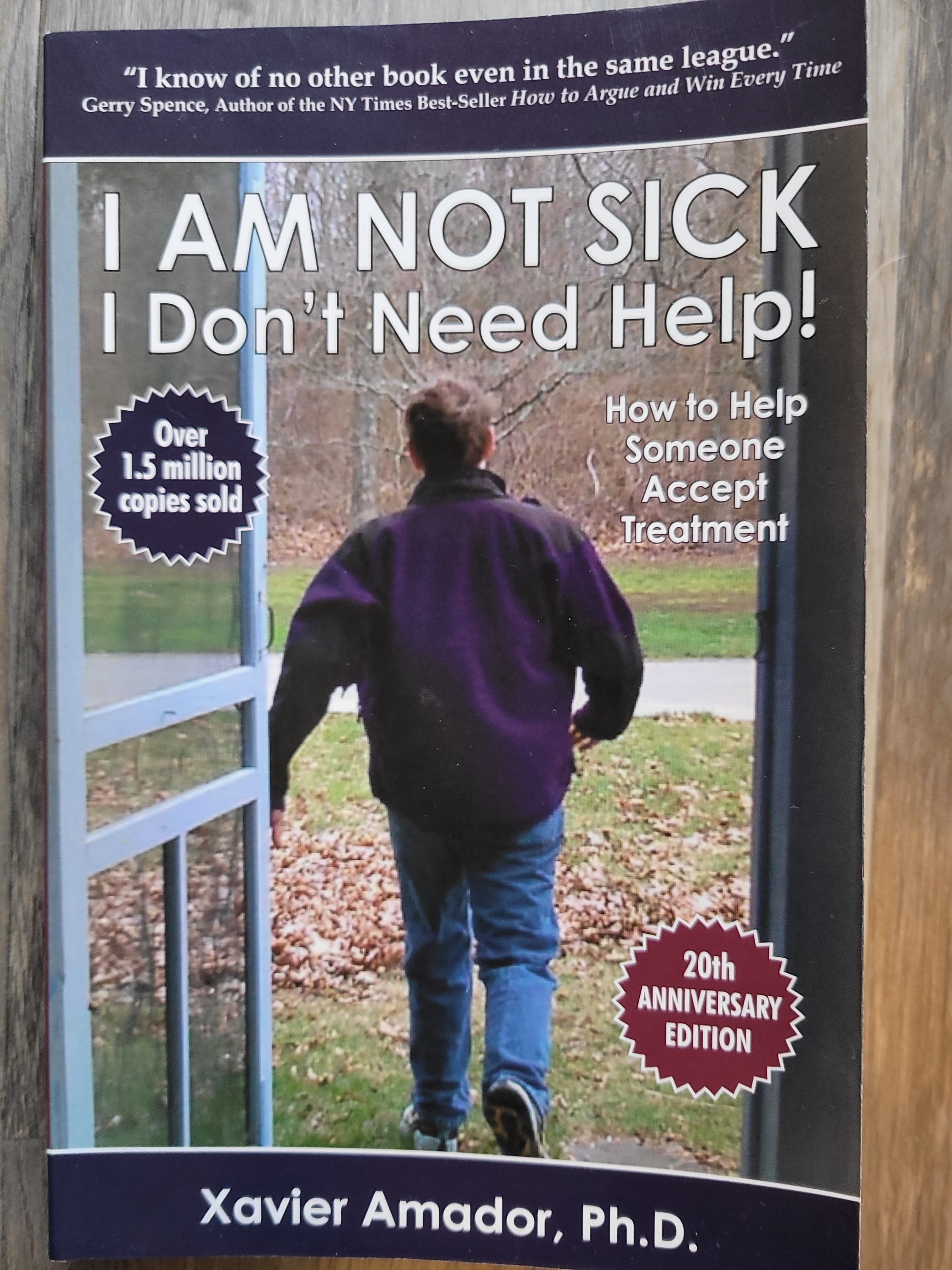
I have a family member who is in denial about his mental illness. At least, that’s what I would have said before I read this fascinating book, “I Am Not Sick, I Don’t Need Help!” by Xavier Amador. I have since learned that in the case of a person with schizophrenia or other mental illnesses with psychosis, thinking you don’t have a problem is a symptom of your illness and not a coping mechanism. There’s a neurological term for it, Anosognosea. Despite the fact that a person is exhibiting mental distress – talking to oneself, having paranoid delusions, or have thoughts of harming themselves, this person may still steadfastly believe that they are not sick.
A comparison the author gives is a man with a brain injury who also has a paralyzed arm. When asked to move his left arm, he thinks he has done it. When it is pointed out that he did not move his arm, and he looks at it while he tries to move it he proclaims that someone must have tied it down. Amador further explained that despite repeat visits to the hospital, the person will still feel they don’t have a problem. However, by the end of the book we learn that research has been done to show that using the author’s approach, recognition of the illness is apparent to the person, even if they call it something else. For example, one woman who had bipolar would describe it as her getting “worn out,” and recognizing that she needed to take her medication so she would feel better.
Just knowing that it is a symptom and not stubborn immaturity or denial, inspired me to read on. Amador describes his LEAP approach, which stands for Listen, Empathize, Agree and Partner. Each step has a chapter dedicated to it with specific examples and conversations one could have with a loved one to encourage them to recognize that they need help. It requires that we put judgement aside, and seek first to understand. The Listen chapter focuses on seven guidelines for reflective listening. The Empathize chapter states that you want to be sure to empathize with feelings stemming from the anosognosia, delusions, and desires. There are plentiful examples throughout the book of dialogue one would have to empathize. The Agree chapter steps through ways to normalize the experience “I would feel the same way if I was in your shoes.” Discuss only perceived problems without labeling them (ie: referring to inability to sleep because one is constantly on guard verses calling it paranoia). The Partner chapter describes ways to find common ground that can be agreed upon. It expresses the importance of delaying stating what you think when the person asks you, until you have had time to go through all the steps.. “I’d like to tell you what I think, but what you think is more important. Can we focus on that, and I will tell you what I think later?” The ultimate goal is to keep the relationship healthy and get the person help.
There is a chapter that caused a great deal of anxiety in me as I read it and it was entitled “Involuntary Treatment.” It was incredibly helpful, and the information is pertinent, just the thought of going through that with my family member brought up the anxiety. The author had a brother with schizophrenia, and he refers to times that he had to go through the process of calling the Crisis Intervention Team of the police force to get his brother involuntarily hospitalized. He said to expect your loved one to be angry with you, and has us empathize with the fact that they don’t think they are ill, so of course they will be angry. He gives examples of dialogues you can have with your loved one when you visit them in the hospital.
The final chapters lay out the research that the LEAP process was based on, and the research that the author and his colleagues have conducted. His final chapter is a touching tribute to his brother, and an explanation of what happened to him.
I wish I read this book months ago, when it might have made a difference. I am not in communication with my loved one now, but if he reaches out, I will be sure to practice the LEAP steps to the best of my ability. I will strongly encourage other family members to read the book as well.
TED talk:


 Moody Paper
Leave a comment