
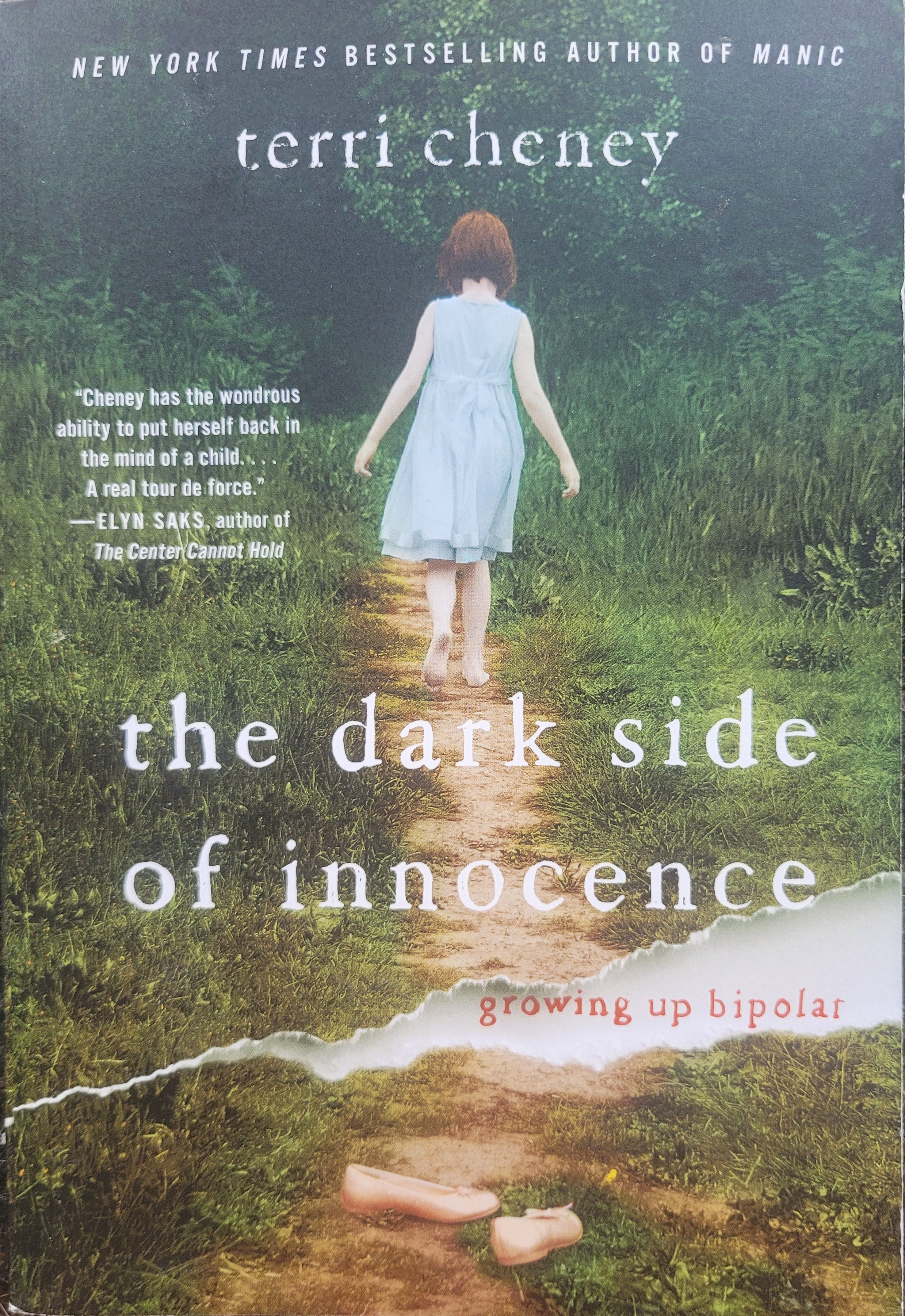
Terri Cheney, the author of Manic, wrote a second book, the dark side of innocence, about what it was like to grow up bipolar. After she wrote Manic, Cheney received many emails from parents with questions about what her childhood was like, at what age her symptoms started, and what it was like to be a child with bipolar.
She wrote the dark side of innocence: growing up bipolar twelve years ago, but I am just now discovering it. I devoured it in two days; most of the parallels between our lives that I recognized were in our teen years, with two commonalities in childhood. I found the book fascinating, and hope that it has brought understanding to parents of children with bipolar.
Cheney had a name for her bipolar symptoms at an early age – The Black Beast. She kept it a secret as much as she could, but sometimes it would overpower her and say and do things she couldn’t control. She lets us into her thoughts and actions as she describes a suicide attempt at the age of seven. She would be absent from school a lot, have her “little spells,” and discovered alcohol as a way to balance out her moods. She was a high achiever and popular in school, receiving all A’s and participating in cheerleading, dance, and student council in high school. While she never uses the term hypersexuality, she writes from her childhood perspective about sexual sensations discovered early and how preoccupied she had become with them at times.
I read the book with fascination, and some recognition. I, too, had a period of time in which I feigned illness due to depression, but I didn’t have a name for it. I was in sixth grade and I was just getting over an illness when my mind was severed from any joy, my limbs were heavy and my will to do anything but rest was lacking. I missed five weeks of school before I was able to find the energy and the smallest desire to go back.
I don’t know why, but when I think about my suicidal ideation, I only think about my adult years, and often forget that when I was in high school I swallowed four or five pills in an attempt to dance around the edge of suicide. My boyfriend had just broken up with me and of course I thought it was the end of the world. I was a very troubled teen, and caused my parents great anguish. I would drink a lot, sneak out of the house, and sometimes stay out overnight. I wish I could take back all the pain that I caused them.
I have found that reading bipolar memoirs is a bit of a compulsion for me; I just received a new one in the mail. I don’t want my summer to be lost in books, though. I don’t know that I need to see myself in more stories, I just need to see myself. I can just as easily do that by being with others, by tackling my to do list, by being in the company of my husband. I don’t have to be alone to feel fulfilled, comfortable, and sane. I have to learn to be in the company of others and still stay in my own skin. Who has written a book about that?


Leave a Reply